
Review
Throne of Blood (1957)
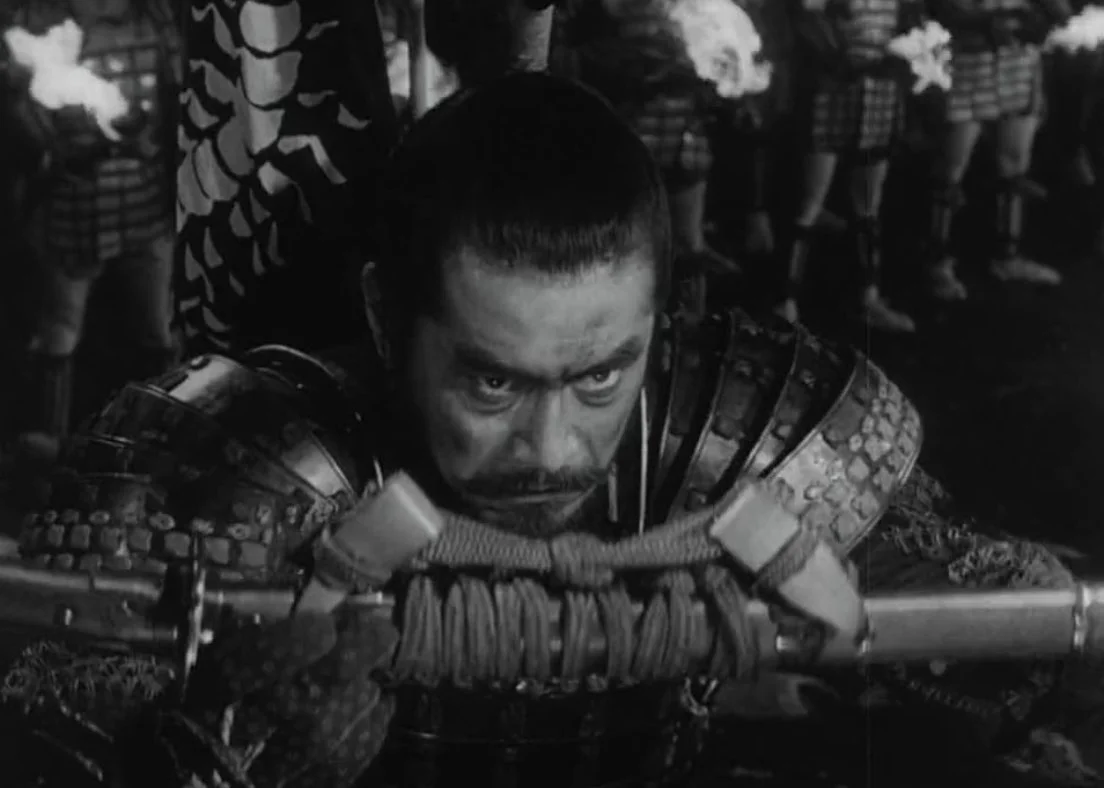
image: Toho
Director: Akira Kurosawa
Writers: Shinobu Hashimoto, Ryūzō Kikushima, Akira Kurosawa, Hideo Oguni
Cast: Toshiro Mifune, Minoru Chiaki, Isuza Yamada, Takashi Shimura, Akira Kubo, Chieko Naniwa, Takamura Sasaki
Run Time: 1h 50m
UK Rating: 12A
10/10
Akira Kurosawa’s Throne of Blood is for me the preeminent screen adaptation of Macbeth. Detractors will point out the lack of Shakespeare's dialogue but it's always the loosest interpretations of the Bard's work (Forbidden Planet (1956), West Side Story (1961), The Lion King from 1994) that prove the most enduring. These are meant to be populist stories and revitalising classic tales has the power to bring them to new audiences who may not be interested in the original formats.
After a series of hard fought victories, samurai commander Washizu (Toshiro Mifune) travels with his closest friend Miki (Minoru Chiaki) to meet with their lord. On the way they travel through Cobweb* Forest and become lost despite knowing the area well. The pair come across an “evil spirit" who professes to know their future, she foretells that Washizu will soon become the ruler of the northern garrison while Miki will be made commander of the first fortress. She goes on to say that in time Washizu will become lord of Spider Web castle and that he will make Miki’s son his heir. They dismiss the predictions as treason and go on to laugh at the idea but upon arriving at the castle the lord assigns the post exactly as the spirit said. Shaken by this encounter Washizu confides in his wife Asaji (Isuzu Yamada) who begins to manipulate her husband into setting the prophecy in motion and secure their ascension. The story will be innately familiar to most in the audience (“the trouble with Shakespeare is all the cliches”) but I will still try not to spoil things with those unfamiliar with the details. The setting and adaptations revitalise the narrative though and it fits seamlessly with other Kwaidan (ghost story) films of the same era. Kurosawa saw parallels between medieval Scotland and Japan, the feudalism and lawlessness in Japan’s pre Tokugawa Shogunate chaos. It's in these times of tumult that societal upheaval is possible and Washizu’s exploits the confusion and paranoia that surrounds him to rise.
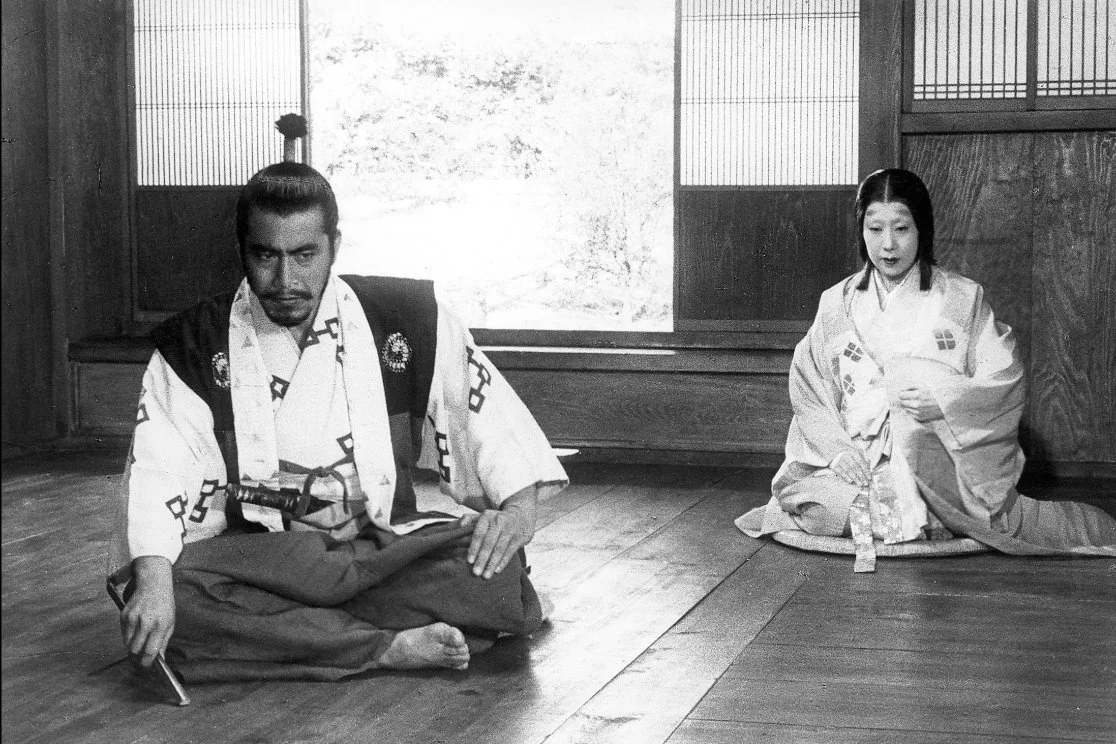
image: Toho
After the relative realism of Kurosawa's earlier period films, Throne of Blood is far more stylistic and influenced by Noh dramas. The emotion is overwrought and the actors' movements seem amplified and almost like dancing. It's especially evident as Washizu erupts in anger and fear during a banquet and Asaji’s mask-like make up design. Mifune’s performance is similarly theatrical, every emotion painted with broad strokes across his face. He’s snarling and bestial in his fury, savage and intense but in fear he’s wide eyed and almost childlike. Isuzu Yamada is my favourite interpretation of Lady Macbeth, Asaji is subtle and almost monotone in coaxing her husband into murderous, unthinkable acts. Her voice is even, she’s gentle as she convinces Washizu to doubt the loyalty of his friend Miki and makes him question his safety in a gentle, even tone. Minoru Chiaki is also brilliant as Washizu’s loyal companion and the pair’s reunion at Cobweb Castle is such a perfect, indelible, small moment. The film does lose character depth with abandoning the monologues and introspective speeches from Macbeth instead having exaggerated expressions to convey emotions. This again is influenced by the masks used in Noh theatre and it is telling that Asaji’s make up so closely resembles the masks used by the stage actors.
Throne of Blood opens on a desolate, war ravaged landscape which must have reminded the Japanese audience on the film's release of the devastation of the post war years. The film's exterior cinematography is eerie and indistinct with thick mist surrounding everything so that it resembles a water colour painting. Kurosawa knew he wanted the film to be draped with fog so he constructed Cobweb Castle on the slope of Mount Fuji, this was a monumental task that required assistance from locally stationed U.S. Marines. It paid off though and the construction is genuinely impressive, even decades later. The forest was a mix of set work and location shooting in Fuji Forest and looks especially creepy with reaching branches and a carpet of low lying fog. The battle scenes lack the spectacle and grandeur of the director’s later works (1985’s Ran and 1980’s Kagemusha) but the floor level camera surrounded by galloping hooves obscuring the action adds massively to the sense of scale and intensity of the scenes. Kurosawa was a master of blocking and staging and it's especially evident in the interior shots where he is able to shoot things like a theatrical production. Each movement feels perfectly choreographed with wide shots isolating Mifune in frame accentuating his increasing paranoia and suspicion.
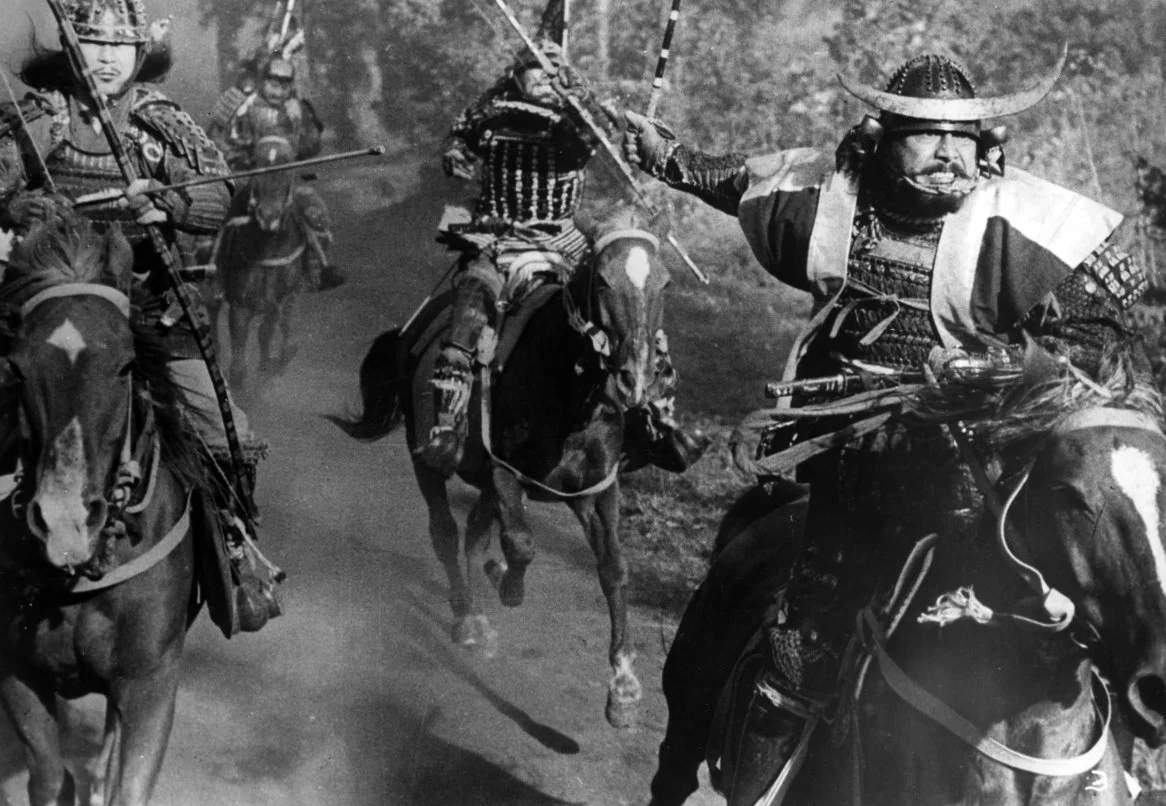
image: Toho
Surprisingly Kurosawa wasn't intending to direct what would become one of his most well regarded releases. Originally the plan was for Ishirō Honda (director of 1954’s Godzilla) to helm the film however once Toho realised the extent of the budget they requested that Kurosawa direct. It's doubtful that another director would have made the bold, stylistic choices that mark Throne of Blood out, even in the director's own filmography. It's a film that is carefully planned but is also impressionistic and emotionally raw. This is Macbeth distilled to its most simplistic form, told like a myth or legend detailing the perils of greed. So though it lacks the tortured inner minds of the source material it still captures the story better than most other attempts.
Watched on Blu-ray (BFI)
*The Forrest and Castle are referred to as Cobweb Castle and Cobweb Forrest on the subtitles for the BFI Blu ray version that we watched, we have seen them referred to as Spiderweb Castle and Spiderweb Forrest in other translations.
Published 9th August 2026