
Review
The Odyssey (2026)
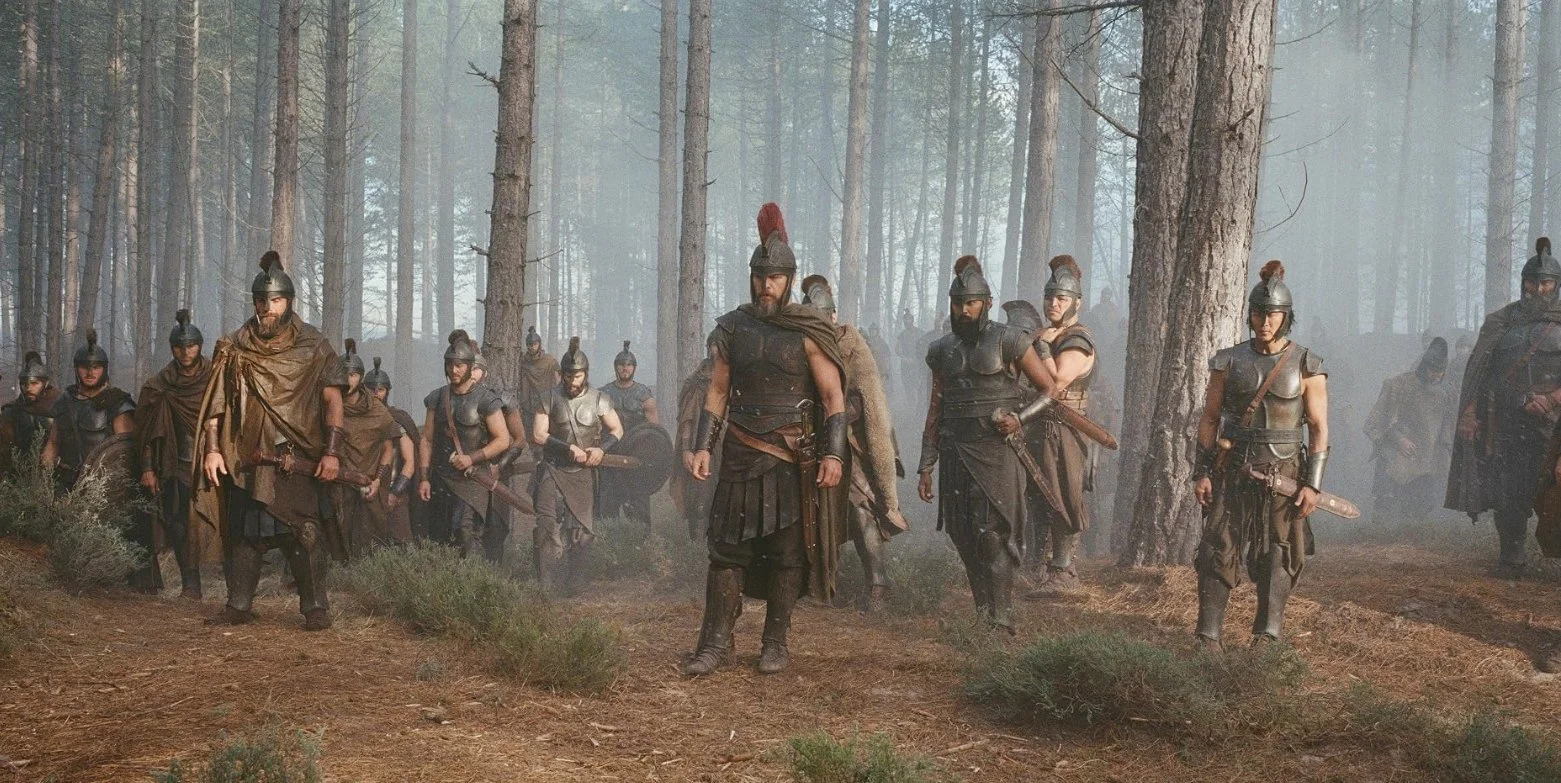
image: Universal Pictures
Director: Christopher Nolan
Writer: Christopher Nolan
Cast: Matt Damon, Tom Holland, Anne Hathaway, Himesh Patel, John Leguizamo, Robert Pattinson, Zendaya, Jon Bernthal, Charlize Theron, Samantha Morton, Lupita Nyong’o, Ryan Hurst, Elliot Page, Corey Hawkins
Run Time: 2h 53m
UK Rating: 15
10/10
There’s a quiet, subtle iconoclasm to Christopher Nolan’s The Odyssey that recontextualises the events of the original story (and other tales of Odysseus’ adventures) in a way that is sure to draw the ire of scholars of antiquities but will resonate with modern audiences. Nolan draws events from The Iliad and The Aeneid, fleshing out events while still adhering closely to Homer's poem. It grounds the fantastical narrative in relatable language and emotions whilst giving us spectacle and scale that is at times jaw dropping. The Odyssey is the first (feature length) film shot using IMAX cameras with a new specialised cover built to reduce the camera’s notoriously noisy operation. With this enhanced level of visual fidelity and screen real estate Nolan focused on creating a believable physical world where even the most monstrous elements of the story look believable when viewed at such massive scale. It’s a staggering achievement and probably Nolan’s best film yet.
Odysseus (Matt Damon) is king of Ithaca and would like nothing more than to remain atop his throne with his wife Penelope (Anne Hathaway) and son Telemachus (Tom Holland) but is instead enlisted into a decade long conflict by Greek ruler Agamemnon (Benny Safdie). In the drawn out siege of city state Troy, Odysseus distinguishes himself with displays of intelligence, bravery and loyalty and songs are sung of his valour. However, after ten years the veterans of the Trojan war have mostly returned, the king of Ithaca and his men are absent. His kingdom is in limbo, law won’t allow Penelope to rule as queen and so without proof or her husband’s whereabouts she weaves while her palace is packed with treacherous suitors. These men drink their host’s wine and food, mocking those still loyal to the King whilst they plot to win the Queen’s favour. Telemachus knows time is running out and soon his mother must choose one of these venomous suitors and sets off to find out the fate of his father from Agamemnon’s brother Menelaus (Jon Bernthal) King of Sparta. Odysseus however is struggling to make his way home, lost and unable to remember his family or what happened to him after the sacking of Troy. He must face the truth of the events on his voyage before he can return to Ithaca.
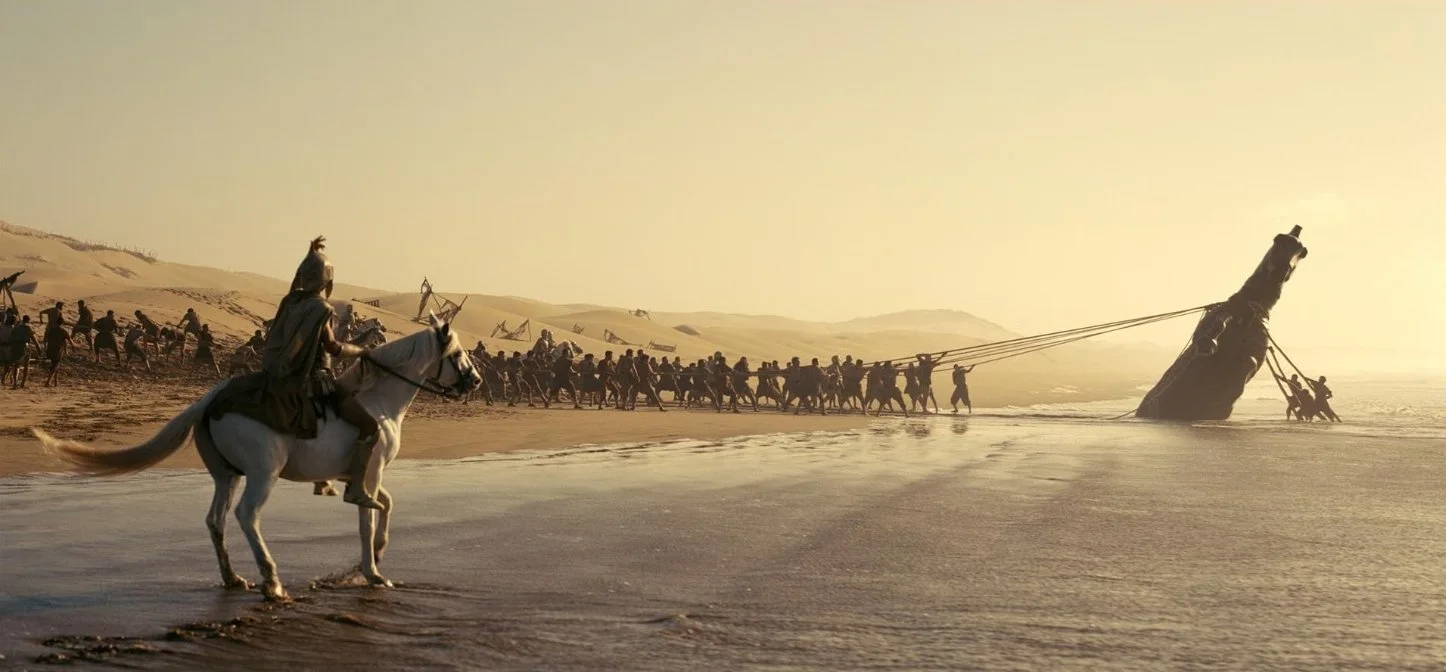
image: Universal Pictures
Homer’s Odyssey is an ancient text, one whose influence is so wide ranging that you’ll recognise elements of the story even if you’re not familiar with the original source material. In adapting something as foundational as the original poem, Nolan has shrewdly condensed and altered the various tales and exploits of Odysseus to present a flawed protagonist who ruefully carries the weight of his heroics. His journey is governed by fate, chance and the capricious favour of the Gods, whose machinations are mostly left unseen. There’s a cost to everything that must be paid and characters are bound to consequences of the decisions that they make. Nolan (the only credited screenwriter) wisely doesn’t depict the Gods atop Mount Olympus guiding the events of the journey instead having them as a tangible presence throughout the film. It reinforces the idea that you must offer aid to strangers as anyone could be a disguised god, Zeus’ law as it’s known in the film is an idea at the heart of ancient Greek morality and one of the central themes of the film. The script uses this golden rule to show how callous the suitors are and dutifully rewards Telemachus’ empathy and kindness. Nolan, whose scripts can be rather perfunctory, has written something that ties together story threads from multiple sources and weaves them together in a way that manages to support the narrative themes.
The dialogue is delivered in unvarnished, modern language, delivered with complete conviction by the dazzling stacked cast. Anne Hathaway’s Penelope is bound to her husband’s fate, trapped in a court that conspires against her and it’s only in whispered, secret conversations with her son that she’s able to speak freely. It’s a beautifully restrained performance from Hathaway, bitterly choking back her true feelings to protect those she loves. It’s also Matt Damon’s best role in years as a reluctant leader damaged by war, we see the full toll of his journey etched into his face. We see Odysseus dramatically altered over the course of the film, from fresh faced husband to worn warrior and Damon nails every nuance of this transformation. Special mention should be paid to John Leguizamo as Eumaeus as Odysseus’ fiercely loyal friend and Himesh Patel’s Eurylochus whose actions here are far more understandable and whose arc contrasts brilliantly with Odysseus. It's one of the most impressive ensemble casts of recent memory and one in which each performance feels perfectly judged.
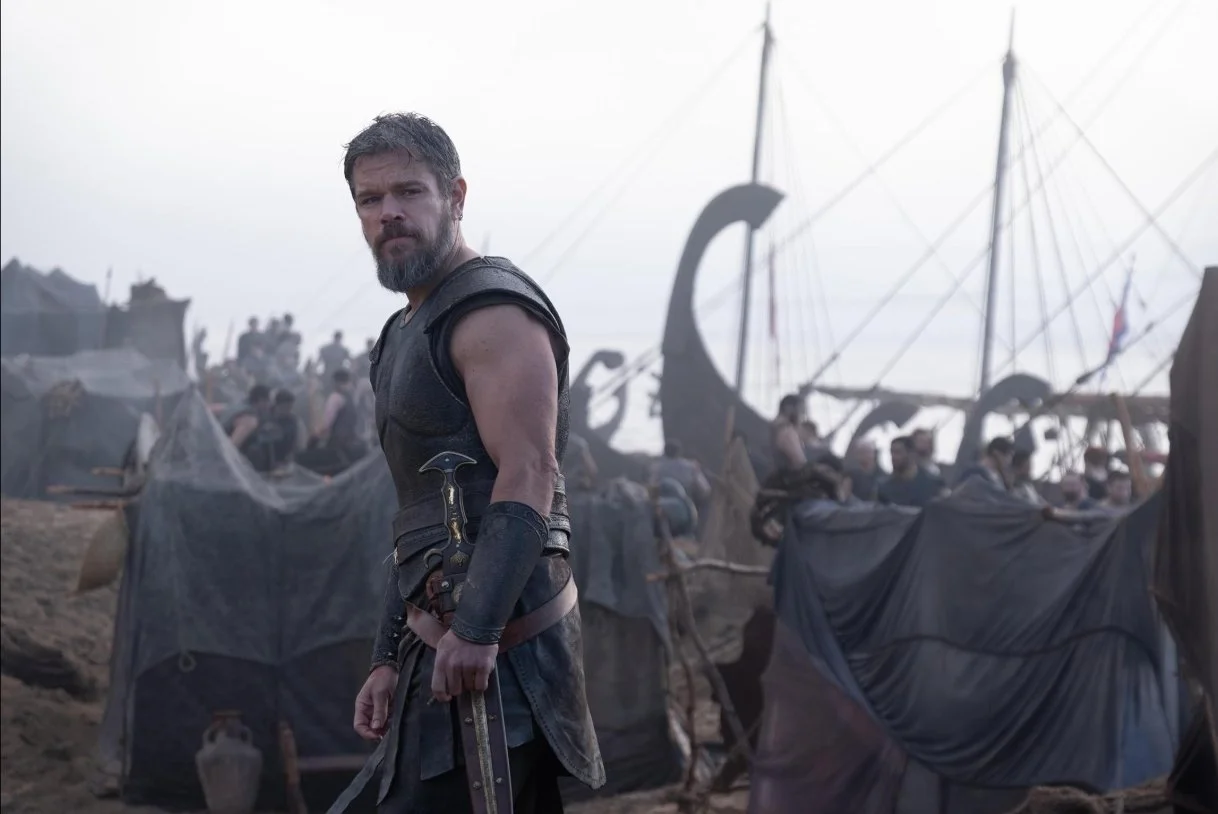
image: Universal Pictures
More surprising is how none of this feels overstuffed even with the runtime being just shy of three hours. The episodic, island hopping nature of the original story ensures the narrative is always barreling forwards into fresh and visually distinct locations (some of which are truly jaw dropping). Jennifer Lame, who edited Nolan’s last cultural event Oppenheimer (2023) (and frequent collaborator with Noah Baumbach) keeps things moving at brisk pace but never loses sight of the characters. It’s an achievement considering the amount of characters and narrative threads within the story and I would be shocked if Lame doesn’t sweep up come awards season. It’s all beautifully captured by Hoyte van Hoytema’s beautiful, expansive photography who uses the extra screen ratio to convey the enormity and scale of the journey whilst still capturing fine, granular detail. Ludwig Göransson’s score which utilises ancient instruments supplemented by modern synthesisers uses subtle leitmotifs to support the themes. It’s all incredibly evocative and the pluck of the lyre used for Odysseus’ famous hunting bow sounds especially thrilling during the film’s conclusion. The Odyssey is packed with unforgettable sequences, the particulars of which I’ve gone to great pains not to spoil as I’m sure it will awe even those familiar with Homer’s poem. It’s rare for a blockbuster of this size to have such a tactile visual texture, achieved by the crew’s dedication to capturing as much as they could with practical effects and ensuring that what wasn’t possible would still be believable within this world. So amongst the crashing waves and gruelling labour, Odysseus’ crew look absolutely exhausted; weatherworn and bedraggled, their decisions feel like the natural choices of desperate men.
If this sounds like too much hyperbole, that’s because I don’t really have any major criticisms regarding the film or the narrative choices made. It’s a thoughtful adaptation that draws from different translations and even some hotly debated real world history to create a singular vision of a story that’s existed for thousands of years. This wasn’t created with the intention of replacing the hundreds of interpretations of these characters but crafting something that will resonate with modern audiences. Nolan makes bold choices that all serve to reinforce his vision of Odysseus as a man, flawed and human but still capable of heroic deeds. It is a cinematic experience to be savoured, one that is almost incomparable to anything else I’ve seen and which should be viewed on the biggest screen accessible to you. Whilst in the past I’ve been critical of the shallow nature of some of Nolan’s previous films this is one that manages to support his vision with characters that are fully realised and fleshed out.
Watched at Cinema: Odeon IMAX
Published 31st July 2026