
In Depth:
The Hit (1984)
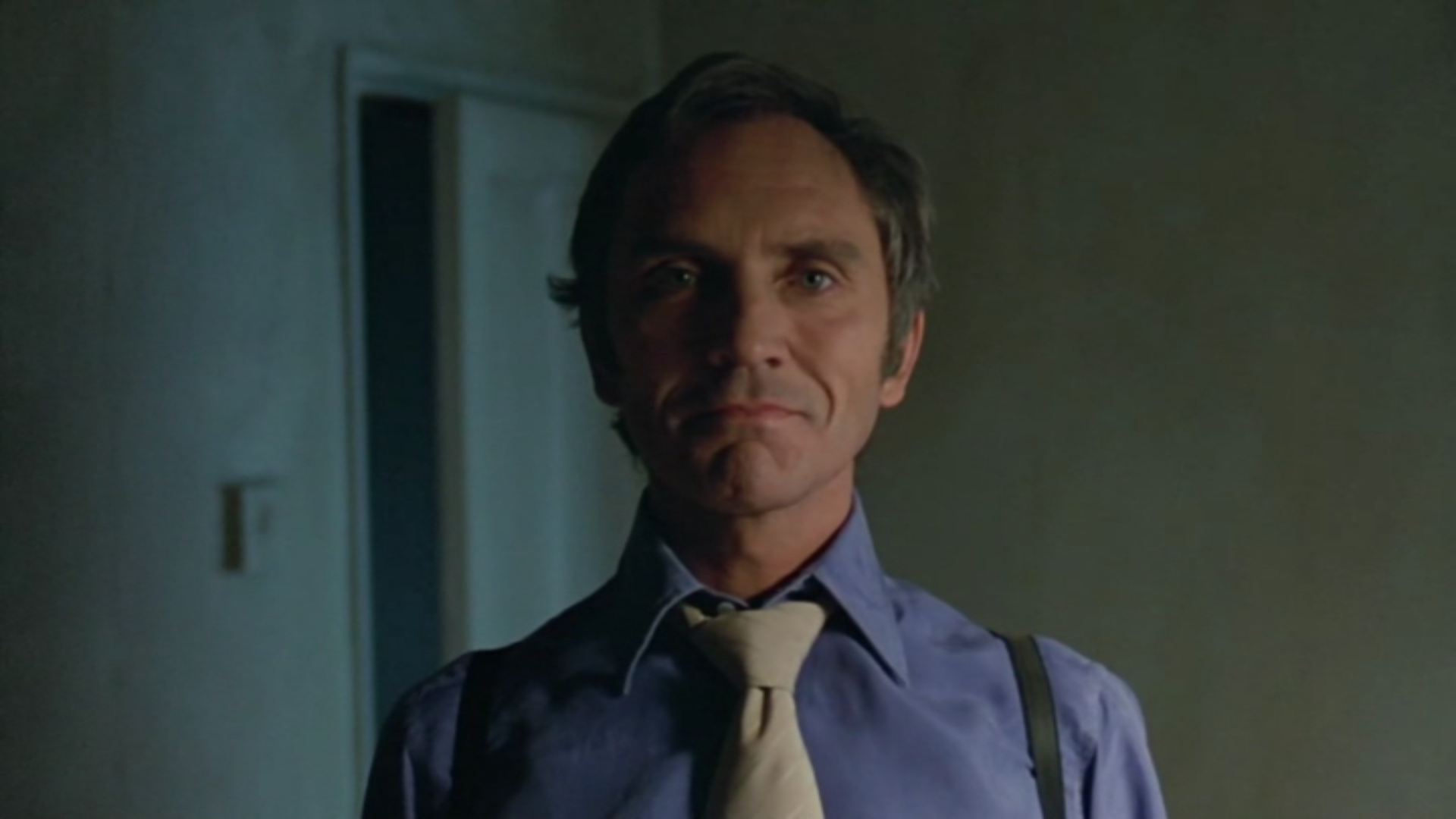
image: Palace Pictures
“It's just a moment. We're here. Then we're not here. We're somewhere else... maybe. And it's as natural as breathing. Why should we be scared?”
The Hit (1984)
Director: Stephen Frears
Writer: Peter Prince
Cast: Terrance Stamp, John Hurt, Tim Roth, Laura del Sol, Bill Hunter
Run Time: 1h 38
UK Certificate: 18
How will you face your own death? Will you bravely accept your fate or do everything you can to cling onto life. No matter how you feel now there's truly no way of knowing until the time comes. That's really the central premise of Stephen Frears’ The Hit (1984). Overlooked and underappreciated on release especially in its native England where it didn't receive a theatrical release (and still doesn’t have a UK physical release). It has since developed a devoted following, cited as a favourite by Wes Anderson, Christopher Nolan and Bill Hader it deals with its subject matter with maturity and a wry humour. Terence Stamp plays Willie Parker, a former gangster hiding in Spain after being persuaded to testify against his former gang. After ten years of reflective seclusion, he's apprehended by Myron (a very young Tim Roth) and Braddock (John Hurt) who intend to escort him to Paris to answer to his betrayal. A simple, familiar premise that's elevated by some fantastic performances, a thoughtful, funny script by Peter Prince and Frears’ naturalistic, patient directing. A Coenesque crime drama although it was released the same year as the Coen brothers made their debut with Blood Simple. The Hit is surprisingly funny, perfectly balancing brutality and humour with ease.
Beyond this point we’ll be discussing the entire plot of The Hit in depth and the ending will be spoiled so I highly recommend watching the film before reading ahead.
When the police come to escort Willie Parker to the courtroom he's reading a paperback in bed with more books stacked around him. The walk down to the car is silent with Parker looking at the grim flats knowing that it'll probably be his last time seeing them. In court he's jocular and playful, having the court erupt in laughter at his replies to the solicitor (a very brief appearance from Jim Broadbent) but he's solemn when asked why he's testifying against his former gang. His former friends. He's asked if he's receiving any incentive to testify which he flatly refutes. “I'm here and I'm saying this because I think I should. I think it's right." As the verdict is delivered his gang begin to sing We'll Meet Again, the wartime anthem popularised by Vera Lynn. Here though it takes on a menacing aspect, what Parker has done will have repercussions. In contrast to the cramped tenements we see at the start of the film, Willie Parker's life in Spain seems idyllic. Leisurely riding his bike through picturesque countryside and chatting with locals. He's lived his years in exile well, surrounded by books in his villa which looks more a library. The darker hair we saw earlier is now Stamp’s trademark shock of white and he looks to be a gentleman of leisure. Parker seems to be a popular man about town, it's clear that he is not a man living in fear or seclusion. When he's apprehended by locals thugs hired by Braddock (Hurt) there's a struggle but when cornered he resigns himself to his fate. When Parker is handed over to Myron and Braddock, the thugs are handed a booby trapped briefcase which explodes incinerating them and their car. The pair will continue to attempt to clear their tracks in the messiest ways possible, in fact drawing more attention to themselves at every turn.
Parker isn’t at all phased or fearful of the men sent to bring him to Corrigan. He has spent the intervening years immersing himself in philosophy and assures his captors that death is simply a fact of life, with no real difference between the two. He treats the journey with amused indifference and even helps fix the car's engine, hastening his own demise. “It'd kill him to thank me, wouldn't it?” Parker jokes as he wipes the engine grease from his hands. For his captors this is at turns, frustrating, perplexing and amusing. Roth’s Myron is a violent, impulsive youth and Parker's nonchalance is an anathema to his understanding of the world one in which he’s probably had to fight for everything he’s got. The pair allude to a savage retribution awaiting him in Paris but Parker remains unfazed. Assuming he doesn't understand what's going to happen to him Myron explains “You silly sod. You’re gonna die!” Parker simply glibly replies “So are you, sooner or later.” After repeated attempts to explain his ideology that were quickly curtailed by Braddock he’s finally able to express it. “I’ll tell you something I read once Myron. Apparently what happens to you after you death is not all that much different from what happens to you before death physically speaking” His speech seems rehearsed as his aborted attempts it began the exact same way. “So if its all the same, really what’s there to worry about?” Myron stares back expressionlessly before replying “You’re barmy” still Parker seems content at having the opportunity to explain himself. His entire personality seems to be centered around this credo and even his wardrobe seems cultivated around a monastic simplicity. He affects a mannered knowing aspect to his speech alluding to it in the reaching open questions he asks Braddock and Myron. Stamp’s Parker is charming, witty and underneath there’s a duplicity that undercuts his credo.
Around the film's midsection Braddock and Myron make what's intended to be a brief stop at their boss’ empty apartment in Madrid. Things unravel when they find the place already occupied by Harry (Bill Hunter) and his young Spanish girlfriend Maggie (Laura del Sol). The careless trail of violence that has been wrought on the journey has already made national news with a promised reward for information and Parker knowingly endangers the couple by informing Harry and Maggie who he is. After some bargaining and assurances from Harry, Maggie is taken as a hostage with the understanding she'll be released safely if Harry doesn't inform the police of their whereabouts. It's an uneasy scene fraught with tension, with Braddock weighing up their lives and Myron leering over the (seemingly) non English speaking Maggie. Parker's impassivity extends to callousness to the fate of these strangers. He lounges around the apartment watching the Aussie Rules Football match seemingly enjoying the change in environment. When they take the apartment owner's Mercedes (with Maggie forced along for the ride) Parker second guesses Braddock's decision to let Harry live. This goes beyond mere detachment and is surely an echo of his pragmatic, brutal former life in the gang. He could have remained silent and the group would have driven away but in speaking up he's protecting his captors and knowingly dooming someone who is essentially an innocent bystander.
Harry is holding the phone when Braddock returns and understands it's over for him. He's still watching the same football match and explains to Braddock that it's his team that are playing. “They're losing" he laments as he stares ahead facing the end with as much dignity as he can muster. Frears and Prince had spend the decade previously working in television and it seems it is this experience gave the pair the patience to relish these small moments. Other directors might have ended this scene with the expected crash of a gunshot but instead Hunter and Hurt are left to play out the scene with subtly and nuance. It's a fantastic performance by Bill Hunter, understated but indelible considering what little screen time the character has. He would later star again with Stamp a decade later in The Adventures of Priscilla, Queen of the Desert (1994) after Stamp recommended Hunter based upon his performance in The Hit. In Maggie we have the direct counterpoint to Parker's acceptance of his fate, she intends to fight tooth and nail (literally) to survive. What little backstory we get from Harry about Maggie (this information is suspect given he doesn't give her correct age) leads us to assume things haven't been easy for Maggie. She's clearly someone well versed in negotiating bad situations and adapts quickly to the group's dynamics. Myron quickly falls for her charms and moves from leering over her to being her protective advocate, even suggesting they release Maggie early on. She uses his obvious naivete to manoeuvre herself towards him and relative safety, understanding that she'll receive no such quarter from Braddock who remains unmoved. She knows he is a man hardened by what he does and he will not be persuaded or show her any sympathy. Laura Del Sol’s performance is largely non verbal but she conveys so much of her character through sheer physicality.
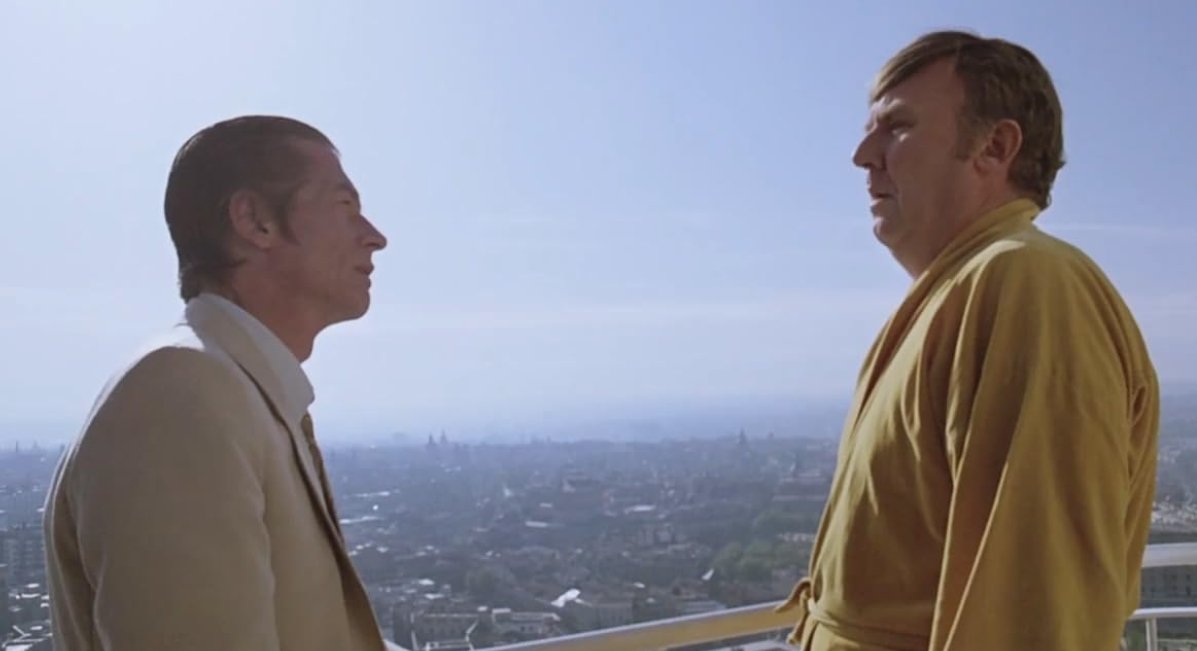
image: Palace Pictures
Their journey across Spain rarely touches upon civilisation, aside from their stop in Barcelona they pass desolate, arid but often picturesque landscapes. Soundtracked by Paco De Lucia’s unobtrusive flamenco guitar score, it's evocative and manages to create a tangible sense of place in these remote locations. Mike Molloy's expansive cinematography emphasises how remote their journey is while capturing its raw beauty. The photography has obvious echoes of Sergio Leoni’s Dollars trilogy in these sweeping, dusty vistas and some shots evoke the grandeur of Ford’s massive westerns. There's a palpable contrast to the tight claustrophobia of the car's cramped close interior shots to the wide, open expanses whenever they escape the confines of the vehicle. They're trying to avoid any more witnesses and with good reason each interaction with the locals quickly descends into bloodshed. The Spanish police are always one step behind, following their messy trail of carnage across the country. This isn't the excessive, cinematic violence of the eighties; we're forced to witness the consequences of Myron and Braddock's brutality as the lead policeman (played by veteran actor Fernando Rey) tries to get ahead of the group.
Myron and Braddock are at opposite ends of their careers but both of them interact with the world with shades of violence. Myron is young and still revels in it, proudly showing Parker the cosh (a small club) that he made during handicrafts school. Parker admires the weapon with professional respect and the audience gets a sense the young Myron craves acknowledgement and praise. When he goes he grabs beers for everyone and discovers the locals at the makeshift bar laughing at him. It needles at his pride but you can tell he's overjoyed at the opportunity for a scuffle. He patiently takes out the weapons he has secreted on himself (a surprising amount that he will show off again to Parker later in the film), laying them neatly on the counter. He clearly is enjoying the anticipation of what's going to happen, carefully stowing the bottles of beer into his jacket before savagely attacking the locals. He's in his element fighting against these four people and although they manage a few hits on him they end up much worse for wear before he runs away destroying the bar in his escape. He's clearly comfortable in this kind of brawl, something that is closer to football hooliganism rather than organised crime. After having to follow Braddock's orders for so long this is Myron’s choice of cathartic release. Tim Roth’s performance is laced through with tragedy and far more depth than a less capable actor could manage. Stephen Frears’ originally envisioned Joe Strummer of the Clash playing the role but suggested Roth to Frears as he was unavailable. Roth’s punkish bleached spikes and combat jacket definitely seem to be still modelled on Strummer but Roth slips into the role with ease. It would have been far too easy for the nuances of Myron's character to be lost in a broader performance but Roth ensures he's a fully realised character. It's clear that this excursion is a series of firsts for Myron his first job, his first time out of the country and perhaps his first time killing someone.
Braddock’s usual violence is uncompromising and final, he kills anyone who poses a threat to him and this job without any remorse. It's only Maggie that he has a weakness for, logically after Harry is killed it only makes sense to get rid of her. She's a liability, one who attacks Braddock numerous times, wounding him and drawing blood. Dragging her along for the ride risks this entire endeavour but even Myron’s pleading for her safety doesn't account for continued survival. When they pull in next to a secluded stream Braddock tells Myron to watch Parker and he'll take Maggie with him as he refuels the car. Myron decides to make the case for Maggie’s survival. “I mean him, he's a fucking grass. He put his mates inside but her, she ain't done nothing." Parker sits watching, seemingly indifferent and unoffended by this line of reasoning. When this falls on deaf ears Myron escalates pointing his revolver at Braddock. He's surprisingly diplomatic, more deft in framing his argument that you would expect. "You're just not thinking right,” he says. “I'm game for anything but Christ there's a limit." Braddock hands over his pistol as an assurance of Maggie's safety and they head off for petrol. Parker takes this opportunity alone with Myron to again propose that it might not be worth keeping Maggie alive. "We don't want anything to go wrong and she is in the way," he gently suggests as if he isn't advocating for the death of an innocent. Myron is incredulous, “You're no different from him, are you?" he replies and he's right. Beyond all of the Zen philosophy there's still a cold, pragmatic professional. Throughout the film he has attempted to undermine the partnership between Myron and Braddock, sowing seeds of doubt wherever he can. At times it seems almost aimless, even insinuating that Braddock doesn’t possess the nerve to kill him but it’s clear this manipulation is second nature to him.
When she attempts to make another escape as the car is refuelled it's the attendant who is killed before he can notify the authorities. Braddock clearly has a personal or professional code that places her off limits, at least for the moment. Their fight as he attempts to drag Maggie back to the car is a brutal slog with the exhausted pair scrambling in the dirt viewed from a high overhead shot. Maggie is shoved back into the car and they return, both worse for wear back to Myron and Parker. On their return Braddock finds Myron asleep in the clearing his gun resting on his reclining chest. Fearing that Parker has escaped he frantically searches and finds him staring unaware up at a waterfall. He approaches gun drawn but simply chooses to watch Parker. It’s a striking shot reminiscent of the stark contrast in David Friedrich’s Wanderer Above the Sea of Fog. The crashing falls feel primal, inescapable and the sound of the water is cacophonous. When Braddock finally makes himself heard above the noise Parker turns to him, smiling inscrutably the sight seems to shake Braddock. Back at the car with Myron and Parker, Maggie makes the case for the three of them using their superior numbers to overpower Braddock. Her English is clear and distinct as she urges Myron to use his gun on Braddock. Again he is trusting of Braddock’s experience and judgement. “I got a feeling about situations. And I don’t think anything’s going to happen, not really.” Maggie roles her eyes at this before turning to Parker “Will you help me?” she asks. He exhales as if the very idea of the question is stupid before flippantly shaking his head. There’s a real callousness to how he reacts to her pleas, he treats Maggie’s desperation as stupid and not worth his time. If Maggie is to live it will have to be of her own volition.
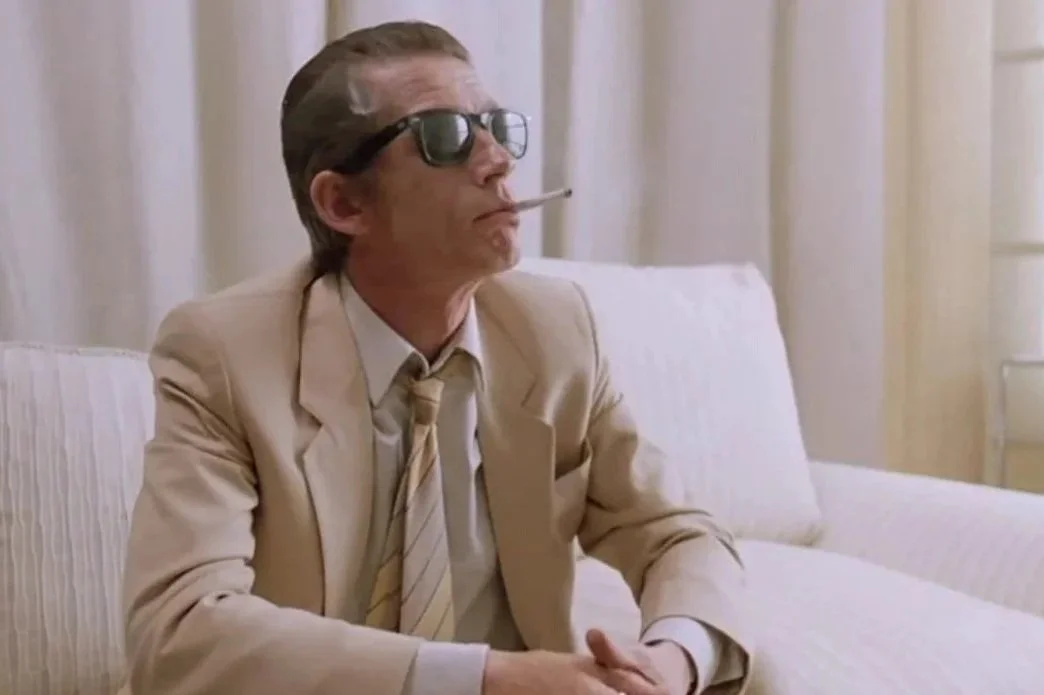
image: Palace Pictures
John Hurt had always wanted to play a typical “heavy” and he relishes the chance giving a performance that exudes a menace and ruthlessness but also manages an intelligence that elevates the character. There's a coldness to Hurt’s performance that's singular in this career, his eyes (often hidden behind sunglasses) appear dead and he sounds utterly exhausted, trademark gravelly voice is at times little more than a growl. He's a character hollowed out and damaged by the things he's done and the only vulnerability he shows is quickly suppressed. Parker approaches Braddock smiling warmly as his captor stands smoking in the moonlight. It’s the only conversation the pair have during the film that isn’t barked orders or commands. Braddock takes the opportunity to ask why he didn’t run away earlier when Myron fell asleep. “You’d have found me again, would have got the boy in trouble.” Braddock asks again why he isn’t scared and to which Parker replies “Why because everyone else is, cause you are?” There’s a moment when Braddock is about to take this as an insult but here in private he softens. “It's just a moment. We're here. Then we're not here. We're somewhere else... maybe. And it's as natural as breathing. Why should we be scared?” Parker assures Braddock that he knew this was coming and the only thing that worried him was the idea that Corrigan would send someone inept to finish him off.
If Parker can be so sure about the end what does that say about Braddock’s insecurities and fears? Considering his predicament Parker is reassuring in telling him that life is transitory and temporary, that there's no difference between being and nothingness. Braddock is unguarded and all the emotions he's suppressed bubble to the surface, Hurt is at his best in this scene allowing himself to be exposed if only briefly. All the hyper masculinity disappears as he wrestles with his own mortality and they treat each close to equals. Parker says he remembers him, “from the old days” not sure if Braddock was calling himself Walsh or Wallace and they both laugh when he insists that his real name is Braddock. Parker reaches into his trouser pockets and unfurls a piece of paper, he tells Braddock that it’s from an obituary of John Lennon that he’s been carrying around since the singer’s death.
“Death, be not proud, though some have called thee
Mighty and dreadful, for thou art not so;
For those whom thou think'st thou dost overthrow
Die not, poor Death, nor yet canst thou kill me.”
John Donne’s Holy Sonnet 10 (usually referred to as Death, be not Proud) is a summation of Parker’s philosophy, that death is just a stage between life and the afterlife. Donne’s poem refers to the prospect of an afterlife in heaven and is addressed directly to a representation/personification of Death. What else is Braddock to Parker but Death, the man who has come to claim him shepherding across Spain like Charon across the river Styx. In this scene, for the first time though, Braddock seems regretful saying he can’t change anything about the job. Parker also softens, “You gonna kill that girl, I don’t think she’s ready” for once advocating for clemency for Maggie. It’s a beautifully shot scene with Frears framing both men in close ups, allowing every nuance of Stamp and Hurt’s performance to be appreciated. Mike Molloy’s cinematography is at its most distinct here with the woods bathed in serene moonlight and shadows creeping across Braddock and Parker’s faces. The emotion and dialogue could have also been overwrought but Prince’s deft script manages to sidestep any heavy handedness while tying up the film’s themes. These two men are both from working class backgrounds unused to emotional vulnerability and Braddock’s clumsy attempts at condolences ring true for anyone familiar these types of men.
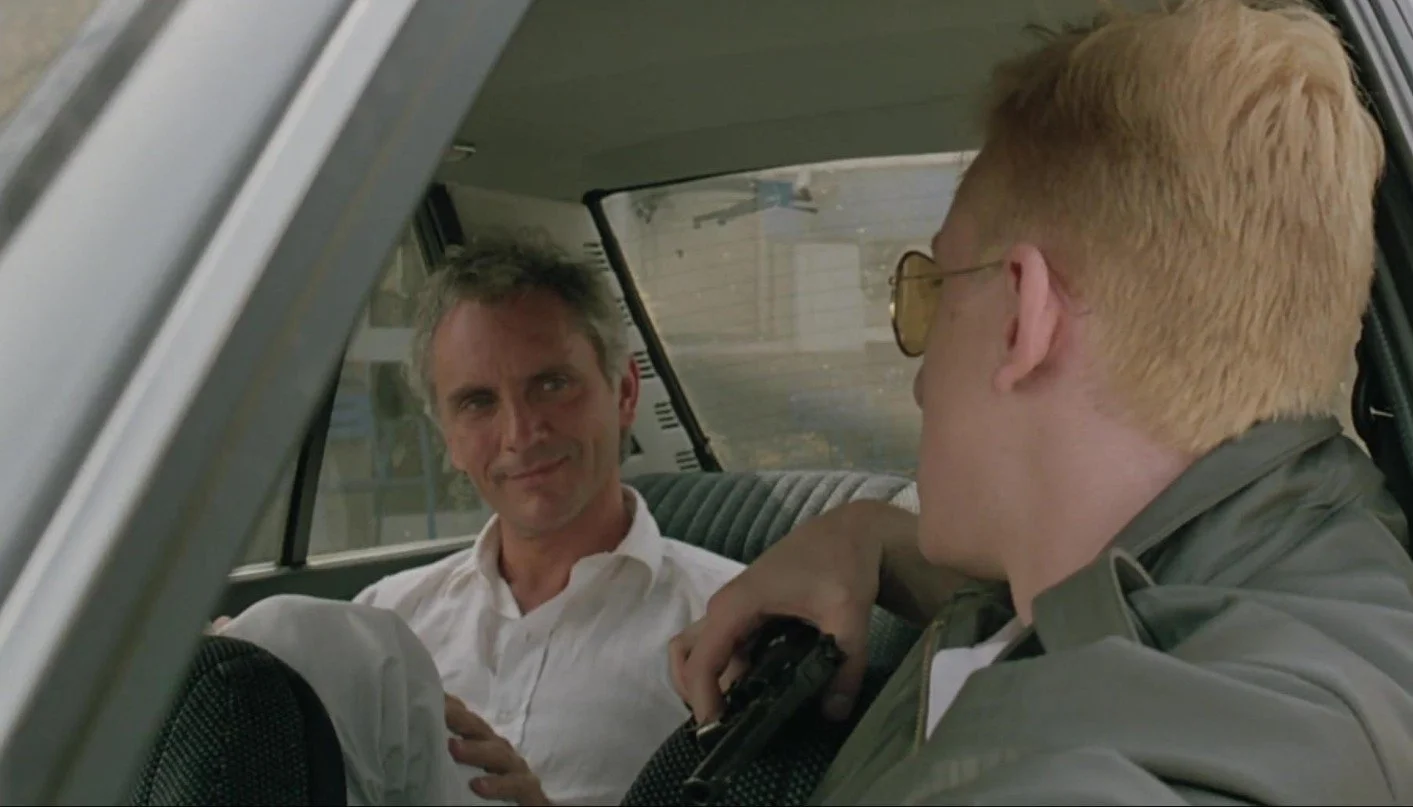
image: Palace Pictures
The next morning they’re off again, Parker fast asleep in the back seat wrapped in a blanket. He seems to be a man without a care in the world. When they pull over on a picturesque hillside it’s for the last time. “He’s a brave man,” Myron says looking at the peaceful Parker in the car he appears to be a man without a care in the world. “Seems so.” Braddock replies, it would have seemed impossible earlier in their journey but his resolute refusal to show any fear has earned both of their respect. Myron admits he’s not up for shooting either of them, the rash, violent man we saw earlier appears to have disappeared and he seems unable to hurt these people who he’s travelled across Spain with. He still asks if he’ll get the full £1000 though, clearly still too mercenary to wash his hands of the situation completely.
When Maggie is removed from the car Parker realises that they’ve decided to kill her. He softly tells her in Spanish to be brave, for the moment she seems also seems to have accepted her fate. “I wish I could have made her understand.” He says as Braddock opens the door. Hurt’s voice is almost a whisper as he replies “You too, Willie.” Parker is ecstatic that finally he’s called him by his name, it’s almost like now at the end they can be friends. He gets out the car still smiling, not understanding they’re intending to kill both of them. At first he’s incredulous, “Not me, you’re doing it tomorrow.” still not believing the reality of the situation. All of the admiration he’s garnered from Myron and Braddock evaporates as his facade falls away. “That’s not the job, the job ends in Paris. You’re not doing the job.” Stamp’s voice which has been so measured and even throughout the film now sounds pathetic and petulant. Myron laughs as he looks to him for help while Braddock looks on with a mixture of shock and disgust. “Willie, you mouth” he says, chiding Parker’s sudden loss of bravado and confidence. Parker turns as if to leave but there’s there’s nothing for miles, Braddock shoots him in the back as he strides to stride down the hill. There was a mixture of hypocrisy at the end too, he easily accepted that Maggie was about to be killed but his own death was still too far in the future to concern him. Would he have had the same reaction had they waited until he they arrived in Paris? Probably not, at least I think so.
Parker was able to build this perfect vision of how he wanted to face his death, probably over the entire decade. He was able to build this persona and present himself as completely Zen without ever having to really test this resolve. It was an ideal, he knew the end was coming after his betrayal of the gang and he admitted that he read everything he could in order to prepare for his death. He constructed the perfect masculine, stoic ideal of an honourable death which in the end he could not fulfil. Perhaps he believed in repeating this mantra he could instill the belief in himself, or that he’d simply trick himself into a death with dignity. There’s also Parker’s bloated ego which is carefully hinted at during the film. He puffs out his chest in the courtroom with pride when he declares he wasn’t offered a deal to testify but because “I think I should. Later however when Myron ask “Why’d you do it, Willie, Why’d you grass?” After admitting that he couldn’t face going back to prison he brags about the deal he was offered. He briefly expresses guilt about betraying his friends but you can see that the nature of this deal was a point of vanity for him “Nobody ever got a deal like that.” This isn’t just hypocrisy it shows that he’s willing to lie for self aggrandisement, maybe his bravery in the face of death was simply a boastful bluster. It’s not unheard of for this type of man to be unwilling to admit or acknowledge their fears or faults. Stamp is brilliant at playing all of the contradictory facets of the character while still having Parker feel consistent and believable. This isn’t to say I believe that Willie Parker is cowardly in how he reacts, it simply undermines everything he has said leading up to this point. His philosophy which he extolled at every opportunity and one which won the respect of his captors was something he could not live up to. There’s tales of people throughout history of people who faced their execution with bravery and defiance who stared down their assailants. It’s romantic and for some aspirational but we simply can’t predict how we’ll face our own mortality.
Myron doesn’t even register Braddock aiming his gun at him, despite the fact he’s watched Braddock dispatch numerous people throughout the film who could pose a threat he naively doesn’t seem to have considered it would extend to him. “What’s this?” he asks still not quite understanding what’s about to happen. Myron seemed to believe that he was part of the gang now, that this job would see him welcomed into Corrigan’s circle never realising how disposable he was. Furthermore by undermining Braddock and even turning a gun on him in defence of Maggie he had marked himself as unreliable, there’s no room for dissent in these organisations. Braddock himself said the same thing to Parker “There’s nothing I can do about this, you know that.” He too is just cog in the machinery of the gang with no room to make decisions or judgements and very little opportunity to escape. Myron is shot without ceremony, shot as soon as he’s finished his question. We’ve seen how Myron has developed from the brutal youth we first see to someone who seems sickened by the violence he’s participated in. Roth softens the character so gradually that the change seems indistinguishable but his death feels brutal. Braddock then rounds on Maggie who’s crouched low cradling her head but again she is ready to fight for her life.
Maggie is a character who has used everything in her disposal to keep herself alive, never willing to accept her fate. It’s no surprise when it’s revealed she was playing possum, using her low crouch to throw soil into Braddock’s eyes. Wrestling him down to the ground again it’s a desperate struggle between the pair as she tries to grab his gun. Eventually Braddock manages to subdue her but it’s a hard fought victory. “Oh aye, you’re a very lucky girl.” he says after knocking her out with the butt of his gun. “Very lucky girl.” Exhausted he moves on to what was clearly the plan from the start. He drives the car to the edge of a forest disguising himself as a backpacker and burns his clothes. With this “Braddock” is dead.
Finally though, Fernando Rey’s policeman is waiting. Each crime they committed had brought the Spanish police closer, their investigation seemed increasingly hot on their tails. At the border he’s waiting with Maggie ready to identify him at the crossing. It’s no surprise that he doesn’t go willingly immediately trying to escape as they descend upon him. When he’s finally cornered in a warehouse, he’s shot falling back into a pile of boxes. He looks at peace as the policeman reads from his numerous passports trying to ascertain his real identity. He doesn’t even acknowledge the questions though because Maggie has found him in the warehouse. Bloody and bruised she’s absolutely fearless as she looks into his fading eyes. “And it’s as natural as breathing.” Braddock recalls Parker now at the end. “Why should we be scared.” It didn’t help Parker when he was forced to reckon with his own mortality but it seems Braddock wants to face death on his own terms. Using the last of strength he winks at Maggie. It’s barely perceptible even in this tight close up but she sees it and understands that he’s acknowledging that she’s won. The only one to walk away from what should have been a simple job. After Braddock slips away we see a funeral as a casket is placed inside a tomb wall. Judging by the Spanish mourner who lay the wreaths we can only assume this is where Parker will be laid to rest. It seems like what he would have wanted when the credits play as his tomb is sealed.
Peter Prince based this story on a real life criminal whose deal to inform on his former gang saw him whisked away to Spain (he was also serenaded in court with We’ll Meet Again) but also on Ambrose Bierce’s Parker Adderson, Philosopher. A short story in which a captured Confederate spy is witty and nonchalant about his impending execution until it’s upon him and he succumbs to fear and panic (sound familiar). The story also has neat juxtaposition of a general who dies with mild amusement, “So this must be death” he says as he slips away. Each character in Prince’s script faces death differently and it is in these moment where we see how they present themselves reconciles with how they really are. Frears’ films seem to focus on how his protagonists deal with points of crisis and here we can see how he treats each of the group with compassion understanding how trapped they all are by circumstance.
It seems baffling now that the film wasn’t a success or that it didn’t even merit a cinema release in the UK but its legacy is clear in some of the crime dramas that followed decades later. Jonathan Glaser’s Sexy Beast (2000) and Martin McDonagh’s In Bruges (2008) both feature the existential musing of criminals out of their element in the continent even Terrence Stamp’s performance in Steven Soderbergh’s The Limey (1999) feels influenced by his role as Parker. The blood soaked road trip became an established genre in itself by the late eighties and early nineties, these films though made clearer heroes and villains and had their criminals be more sympathetic and relatable. The Hit seems uninterested in making these characters into simple, easily digestible archetypes instead preferring to show human fallibility and weakness. Perhaps the nebulous and inscrutable nature of the narrative and characters is reason for the film’s commercial failure, on release the marketing especially struggles to find an angle in which to sell it to audiences. Might it have been more at home in the more downbeat, fatalistic cinema of the seventies or perhaps modern audiences would be better attuned to the film’s esoteric charms? Still, The Hit remains an essential, endlessly rewarding film that still feels as fresh and vibrant as it did over forty years ago.
Published 9th July 2026